What Remains
In my opinion, a photograph is pure magic. It has the power to transport you to another place, to another time, perhaps to another you. Nowadays with my smartphone I document everything, my family holidays, my artwork, my inspirations, my environment. I even snapshot my shopping list.
In 2004, I took a set of photos to mark the end of a family era, a transition in our lives and exhibited them under the title of “What Remains.”
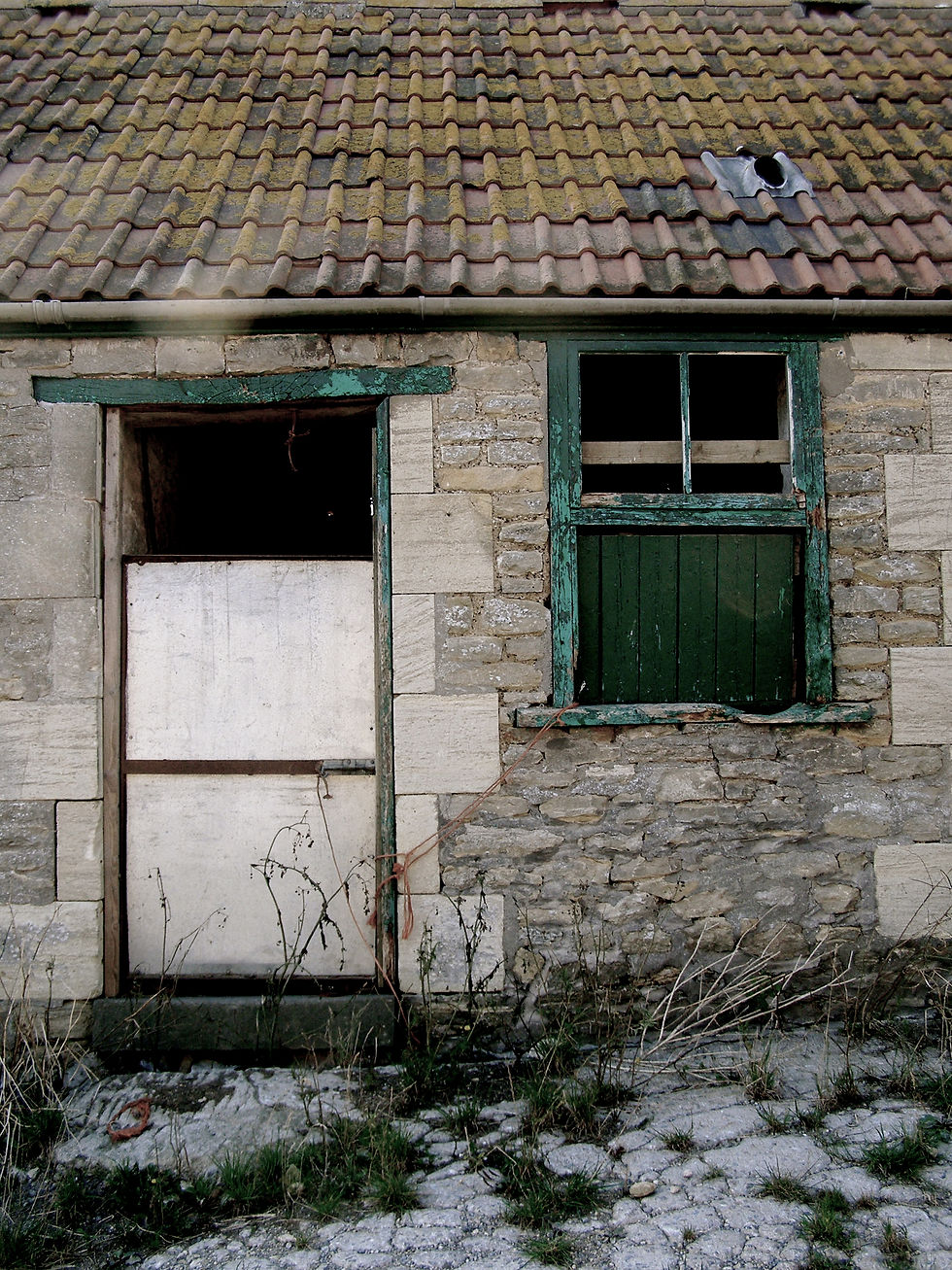
The photos are largely of spaces that had once been busy working environments, now silent and still: derelict buildings, Nature quickly taking back what was rightfully Hers. But for me, what they visualised was our history, our stories and for my husband, his life thus far.
We were no longer dairy farmers and this place would no longer be ours. In the pictures, the barns are cleared for redevelopment, the large concreted spaces, devoid of cattle and calves. My father-in-law’s dog is the only life, he searches for what had always been there and will never be again.
As I look at the pictures, I imagine the “before”. Here, the cows chewing their cud, a fountain of shit spraying from their behind. They’re waiting to be milked. There are flies buzzing everywhere, my husband’s walking towards me, he’s dressed in a green plastic apron and flat cap, wellies sloshing through the ankle deep muck. Behind him, the parlour, which is as clean as a new pin, reeking of chlorine and iodine, ready for the cows.
The parlour is a herringbone design. The milker works in the centre several feet below ground level. The cattle enter and because the farmer is below them, he is able to easily reach the udders and place the clusters on their teats. The cattle eat a calibrated diet, specifically aimed at that animal and where they are in their lactation. My husband, Ed, is in the firing range of 10 cows back legs but because they know him, he is rarely kicked. He is, however, often peed or shat on. It’s definitely not a white collar job!
The parlour hums like a steam engine.
Man, animal and machine.
The leader cow, always the first, shows the way. The milk pumps through clear glass tubes to a large chilling collector outside.
One of life’s greatest pleasures was drinking milk straight from the bulk milk tank, ice cold and raw.
Now all gone.
All removed.
The ghost of my young son, now a vet, in his wellies, in his mini apron, not five years old, helping Ed in the parlour at weekends. They both know the cattle by sight, number 105 with the dodgy eye, number 227 who has mastitis and needs antibiotics, number 384 which gives more milk than any other cow in memory.
Another picture, another story. Right here is where the cow prolapsed, her innards pushed completely out in labour. It was a hot July day and Ed and the vet saw me nearly pass out at the sight, sending me off to the vets car on a false errand.
And in this place I set up a video camera in a fish tank and recorded the cattle from the ground up. A strangely beautiful video of hooves, muck, saliva and wet noses. An installation that I later projected in the gallery in a horse box on some feed sacks.
One memory that stands out to all that lived nearby, were the cows waiting to be milked. The outer wall of the collecting yard stood above the road by several meters. The cows, ever curious would stand in a row, chewing their cud and watching the cars and people pass. 12 or 15 heads in a row following the passerby’s in unison.
The cows have now gone to pastures anew. Another farm, another dairy.
And the farm, this new farm was finally ours. Until this time we had been tenants of Wessex Water Authority. But the effluent that 150 cows create, had increased the nitrogen levels of the soil, and in turn, the watercourses. We had been offered the farm in exchange for losing the dairy herd.
Whatever happened we would lose the dairy herd.
The photos are bereft of cows, of people, of life. They are barns, empty, some old and broken, others patched together in different colours of corrugated tin.
Three years earlier we had faced the potential of losing the cows to Foot and Mouth. And the documented photos, the official ones, are not dissimilar to the ones I’m looking at now.
They convey a sense of loss.
For farmers the Covid story is a rerun of the Foot and Mouth disease.
They’ve seen it before: in their sheep, their pigs, their cows.
Foot and Mouth was for the farming industry as, if not more, disastrous than Covid.
Whole herds exterminated.
And under the government rulings potentially devastating.
Animals didn’t need to have been affected to be slaughtered. They just needed to be within a 3 mile radius of one animal that had tested positive.
What people don’t realise was the depth of the loss, not just to farmers but the culture of animal production. Prize herds that had been created over decades or even centuries, were lost forever.
Some hereditary lines of what makes British meat so good, expelled.
Vets, and student-vets were called in to work shifts that are seen today in the NHS, but not to heal, cure or tend, but to kill. Hundreds, by each vet, every day. Every farm, small holding or pet within an infected zone, slaughtered.
And then burnt.
The official documented pictures of the Foot and Mouth paint as horrifying stories as the current footage of bodies in the Ganges. Except that the Foot and Mouth pictures only show the aftermath. Where once there was life, there is only emptiness. No gory death, no views of what was there before, empty barns, dairies, sheep pens. An austere heavy silence pervades the Foot and Mouth pictures. The eyes of the vets, dressed head to toe in blue-scrubs and masks are tearful or as empty as the space they now stand.
For us on the ground, it was a potential crisis and a worry that clawed your waking dreams and left you suffocated and wheezing. Like Covid, a morbid fascination pervaded our lives, to listen to the news, to discover where or what the disease had mastered. I stopped working at school. The children I supported would have to wait.
My children, 5 and 7 on the other hand would need to be walked to the end of the lane to meet the school bus. There was a carpet laid out across the road which we kept drenched in disinfectant. A notice was erected pleading people to stay away. Everyone, everything was a potential carrier. One great issue was what to do with the milk? Whatever happened the cows would need milking. But would we allow milk tanker to collect the milk after visiting another farm?
But on the same lines it was sacrilege to throw it away. 1000s and 1000s of litres dumped on the field.
When Covid struck, one of the most extraordinary sights were the rows of empty shelves. Food deliveries couldn’t keep up with the mass hoarding of food supplies. Bread, milk and bizarrely toilet rolls were rationed per customer.
Ed has never got used to buying milk, the taste after pasteurising, the lack of cream. We no longer drink it except cooked in porridge or in tea. It’s just not the same.
Whatever some people say about farmers, their animals are the centre of their business. The more you care for them, the better the product. Because the meat produced is a product. They are like temporary employees in a factory, the happier the staff, the better the output. Man and animal working together, each with a role to fulfil.
It is different when it comes to dairy cows. Dairy cows are special.They are the makers of life, their calves grow up to be the next generation of milkers, they are the makers of our milk. And they are on the farm for the long term. Most are born on the farm and never leave. The farmer will spend
7 hours a day, every day, with them. And the hours away from them, will be to produce their winter fodder — cows will stay in all winter —, cleaning their barns, in maintaining the pastures.
All jobs just to serve the cows.
A highlight of the agricultural calendar is the first time the dairy cows go out in the fields after the long, wet winter months. The first scent of spring grass sends them waiting at the covered yard gate. There is a longing, a yearning to be out. They may need to wait for days, The ground too wet but there is no persuasion. Ed calls them and they literally run. It begins with a slow rumble, hooves pounding the earth, like distant thunder, with the realisation that the grass and open space is theirs. And then the thunder reaches a crescendo as 150 cattle charge into the field and prance and skip, like children at play time. It is a sight that makes you giddy with delight.
If the worry of the impeding Foot and Mouth disaster didn’t cause my husband to have a breakdown, the bureaucracy surrounding it, soon would. It was joked that the paperwork to move an animal now across the street from one field to another — not one farm to another, was longer than the walk. And it was true. Each animal had a passport and a type of visa system was set up with official permits needed in triplicate before permissions for movements were granted. The milking herd were forced to remain in that summer; it would be impossible to get the permits everyday, twice a day. I built a passport control box for the cows. The dairy cows were milked and then forced to walk through it on their way to the outer barns in the cow yard. It was another artwork, a political statement of how Foot and Mouth changed the shape of farming.
Of course, only the art still exists.
Much of the bureaucracy and hygiene legislation that began in Foot and Mouth still exist. We often wonder Ed and I, if Covid could have been prevented or at least reduced if we had followed government rules set out for animal welfare. Cattle, sheep and pigs are not allowed to be packed and transported in tightly contained vehicles. The tube, the buses, the planes would never adhere to DEFRA directives. And how many of these modes of transport are disinfected? For farmers, its every time they use a horse box, or lorry, no matter how long or short the journey. In todays world a horse box is so clean you could eat your dinner off it.
We all hoped the UK would never have another epidemic like Foot and Mouth thanks to the government regulations put in place. Of course a human epidemic was never considered and Covid was harder to control because the disease affected humans. Mass killings could not occur. Not like the lorries stuffed with dead bodies that dripped blood on the streets, turning them red and putrid in the sun as on many minor roads near our close friends in Carlisle. They lost a flock of 1000 sheep and a large beef herd. Located next to a major furnace, the smell of burnt flesh prevailed the air for months; the ash from the furnaces reshaped the contours of the Cumbrian landscape.
My best friend was married in Scotland in September 2001, at the height of the Foot and Mouth outbreak. After much deliberation I went, choosing to fly and reduce the chance of spread. Looking down from the plane, our country was a map of bonfires. Few cars in the rural areas could be seen. It was gratifying to see that people were avoiding animals for the sake of the animals.
Funny to think that in Covid times, the numbers of people revisiting the country were looking for escape and a desire to avoid people.
In all, over 6 million cows and sheep were slaughtered, the government’s “operation” to halt the Foot and Mouth disease. Thankfully our animals were never affected but we came dangerously close to being so, the nearest infected site was in Chipping Sodbury, not 11 miles from our farm.
Of course we don't have milking cows any more either, but at least they lived to tell the tale. And we do have a thriving business, one that is based around beef farming and horse liveries. My husband’s work load has massively reduced and we no longer have the extreme ties that only dairy cows create. However, he still misses the girls as he likes to call them and when he looks at the pictures in “What Remains,” he is always quiet.
It was the end of an era and we didn’t know then whether the farm would and could sustain us as a family and business.
And yet it is still hard to forget that we no longer milk, even now, 17 years on, almost to the day. I still look for the black and white Friesians when I come home from a holiday or extended trip.
But, clearly, they are no longer there.
Sometimes I imagine my sons walking them past my house ready for milking: the moos, my children’s voices, the flies, the muck, and I look out and see the road empty like the photos.
And what remains is us,
Our stories
And with luck a future without the peril of Covid, and Foot and Mouth.

Comments